FAQs
The questions we get asked most.
40 straight answers, written by the blokes who do the work. If yours is not here, ring us — we would rather spend two minutes on the phone than have you guess.
- No jargon, no waffle, no "it depends"
- Prices and quotes explained before you book
- The Queensland rules, linked and dated
- Both trades, because most jobs need both

- Licensed electrical contractor #91702
- ARC #106899
- Fully insured
- Owner-run since 2022
- Deception Bay, QLD
9 questions
The basics
Licences, what we do, what we do not, and what you get at the end.
What areas do you cover?
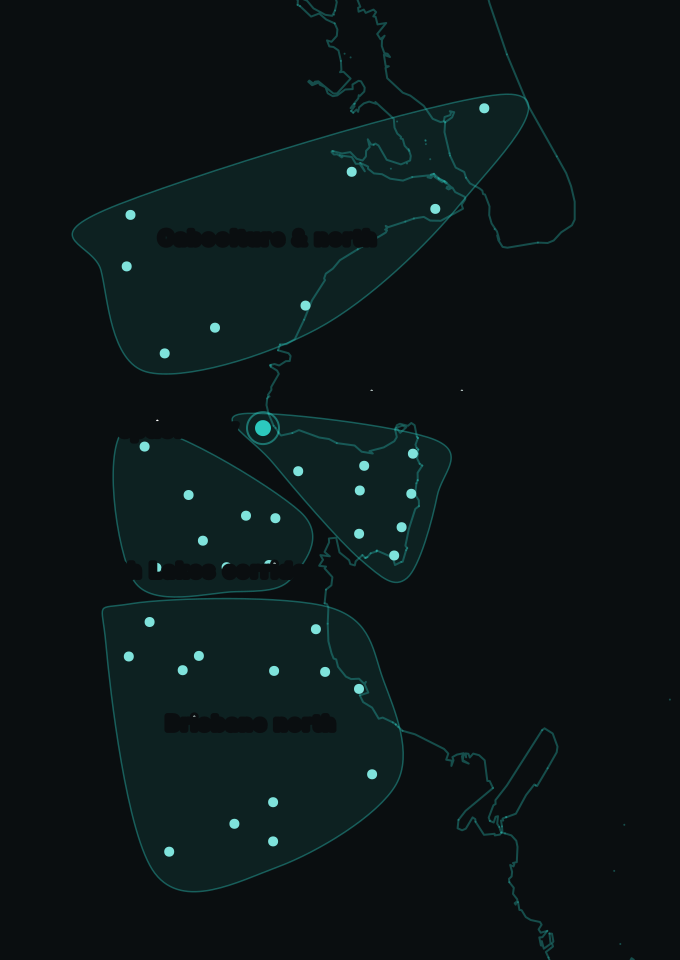
We’re based in Deception Bay and work right across North Brisbane and Moreton Bay — the Redcliffe peninsula, the North Lakes corridor, Caboolture and north, and Brisbane’s northern suburbs.
If you’re not sure whether you’re in our patch, send the suburb through and we’ll tell you straight. If it’s a stretch for us we’ll say so rather than waste your time.
Do you do both electrical and air conditioning?
Yes — that’s the whole point of us. Same crew, same job, one quote and one invoice.
Most air con installs need electrical work anyway: a dedicated circuit, an isolator, sometimes a switchboard that’s had its day. When one trade does the lot there’s nobody to blame and nothing to wait on. It’s also why we can sort the wiring and the unit on the same visit.
Do you do commercial work, or just houses?
Both. A fair bit of what we do is commercial and construction — warehouses, shops, fit-outs and new builds — alongside the houses, renovations and rental properties.
Commercial jobs come with their own bits: roof and height access, inductions, working around a business that still has to trade, and a work order reference on the invoice. Tell us what the site is and we’ll quote it with all of that in it rather than discovering it on the day.
Are you licensed and insured?
Yes, and the numbers are on this website so you can check them.
Electrical contractor licence 91702, electrician licence 169702, and ARC refrigerant handling licence 106899 for the air con work. We carry public liability insurance — a Queensland electrical contractor licence requires it.
Ask any sparky for their licence number before they start. A real one will hand it over.
How do your quotes work?
You get a price in writing before we touch a tool. That’s the promise the whole business runs on.
Tell us what needs doing — photos of the switchboard or the unit help a lot — and Dylan or Hayden will call you back to check the details. Then the quote comes through in writing. If you’re happy with it, we book a day. No surprise numbers at the end of the job.
Can I supply my own light fittings or air con unit?
Usually yes, and plenty of people do.
Two conditions: it has to be compliant gear for Australia, and the warranty on the unit itself stays between you and wherever you bought it. We’ll warrant our installation either way.
Send us the model before you buy it and we’ll tell you if it’s suitable for the spot you’ve got in mind — that’s a cheaper conversation than finding out afterwards.
Do I get a certificate for the work?
Yes. Any new or altered electrical installation work gets a Certificate of Testing and Compliance, which is what says a licensed electrician tested it and it meets the standard.
You get a copy — keep it. A conveyancer, an insurer, a building certifier or a property manager will eventually ask for it, and it is much easier to hand over than to chase up years later.
Builders get theirs as the work is completed so nothing holds up handover.
Do you do plumbing or gas fitting?
No. We’re electricians and air conditioning installers, and that’s where we stay.
If your job needs a plumber or a gas fitter as well, say so when you get in touch. We work alongside other trades on builds and renos all the time and we’ll tell you honestly what’s ours and what isn’t.
Will you make a mess of my house?
We clean up after ourselves. Drop sheets down, dust vacuumed up, old fittings and packaging taken away with us.
Where a wall or ceiling has to be opened we cut neat and tell you first, so you know exactly what you’re getting back. Plaster patching and painting we leave to you or your painter unless you’d rather we organise it — just ask while we’re quoting.
Shoes off inside if that’s the house rule. No worries.
3 questions
Prices & quotes
How a quote works, what a call-out costs, and what is included in the number.
Do your prices include GST?
Yes. Every price we give you is the total including GST — the number on the quote is the number on the invoice.
If you need a tax invoice for a rental property or a business, just say so and we’ll make sure it’s made out correctly.
Do you offer a pensioner discount?
Yes — 10% off for pensioners. Mention it when you get in touch and it comes off the quote before you see it, rather than being something you have to ask about at the end.
Bring your card out on the day and we’ll have a quick look, same as anywhere else that offers it.
Do you charge a call-out fee?
Most work we quote up front, so there’s one number and no call-out on top.
Fault finding is the exception. Nobody can price a fault they haven’t seen yet, so that’s charged as a call-out plus time. We’ll tell you both numbers on the phone before we drive out, and once we know what’s wrong you get a written price for the repair before we start on it.
No surprises at the end. That’s the whole point of quoting first.
3 questions
Booking & access
How soon we can get there, and whether you need to be home.
How soon can you get here?
Send the job through and we’ll call you back to book a day that suits you. How quickly we can get there depends on what’s already on the board that week, and we’ll tell you straight rather than promise something we can’t hit.
If something is unsafe — burning smell, sparks, a hot switchboard, water near wiring — don’t wait on a form. Turn the power off at the switchboard and ring us.
Do I need to be home while you work?
Someone needs to let us in and be contactable, but it doesn’t have to be you — plenty of jobs are done with a neighbour, a property manager or a lockbox.
Tell us how access works when we book it in. If the power has to go off for part of the job we’ll tell you roughly how long, so you can plan around the fridge and anyone working from home.
Can you handle compliance across a whole rent roll?
Yes. We’d rather do a batch of properties across a week than one a fortnight — it’s cheaper for the owners and far less chasing for you.
Send the addresses and we’ll work through them, contacting each tenant to arrange access ourselves. Every property comes back with its own photos, notes and documentation, and its own invoice with your work order reference on it.
Nothing bundled across addresses. That’s usually the bit that causes the headache.
11 questions
Electrical
Safety switches, switchboards, smoke alarms, downlights and points.
Why does my safety switch keep tripping?
Because it’s doing its job — something is leaking current to earth and it’s cutting the power before that goes through a person.
Common causes: a faulty appliance (kettles, dryers and old fridges are regulars), water in an outdoor point or a light fitting, or damaged cable. Nuisance tripping under load usually points at one appliance.
Unplug everything on that circuit and reset it. If it still trips, stop resetting it and call us.
How do I know if my switchboard needs upgrading?
Open the door and have a look. Ceramic fuses with fuse wire, no safety switches, rust, scorch marks, a missing cover, or no room left to add a circuit — any of those and it’s time.
The big one is safety switches. If there isn’t one on every circuit, or there’s only one covering the lights, the board is protecting your wiring but not you.
Send us a photo of the inside of the board and we’ll tell you straight.
How long does a switchboard upgrade take, and will the power be off?
Most domestic boards are a half to a full day, and yes — the power is off for most of it.
We’ll agree a start time that suits and work straight through rather than spreading it over two visits. If you work from home, or there’s a freezer full of food, tell us while we’re quoting and we’ll plan around it.
If the meter or the service cable has to be touched, Energex gets involved and we’ll explain what that adds before you commit.
Can you put a power point outside?
Yes, and it’s a common one — patios, sheds, pool pumps, Christmas lights, the caravan.
Outdoor points need a weatherproof enclosure rated for where it’s going, and the circuit needs safety switch protection. A point under a covered patio and a point on an exposed wall are two different enclosures, so we’ll have a look at the spot before quoting.
Sheds and granny flats are often a bigger conversation — a sub-main rather than a point. We’ll tell you which one you actually need.
Can you swap my old halogen downlights for LED?
Yes, and it’s one of the better-value jobs going. Halogens run hot, burn a lot of power and need globes replaced constantly.
We remove the old fittings and their transformers rather than leaving them in the ceiling, and fit LED downlights with the right beam angle and colour temperature for the room — warm white where you relax, neutral where you cook.
While the ceiling is open we’ll tell you if the layout is wrong. Moving two lights often does more than replacing ten.
My switch and power point covers are cracked and yellow. Can you replace those?
Yes, and it is one of the cheapest things you can do to a house. The cover plate is the part you touch and look at every day, and swapping a room’s worth of cracked, sun-yellowed ones for new white or matt black takes a fraction of the time people expect.
It is worth doing while we are there for something else — the labour is already on site, so you are mostly paying for the plates. If a plate comes off and there is something behind it we are not happy with, we’ll show you a photo and tell you what it needs before we do anything about it.
Can a ceiling fan go where my light is now?
Usually, but not always, and the reason is the fixing rather than the wiring.
A fan is several kilos of spinning weight. It has to be fixed to a ceiling batten, a joist, or a brace we install between them — plasterboard on its own isn’t a fixing. Where the light sits between battens we fit a brace from the roof space.
You’ll also want a separate switch or a wall control for the fan, which is a second consideration we’ll cover in the quote.
What are the Queensland smoke alarm rules?
Alarms have to be photoelectric and meet AS 3786-2014, must not contain an ionisation sensor, must be under ten years old, must work when tested, and must be interconnected so when one goes off they all go off.
They go in every bedroom, in the hallways connecting bedrooms, and on every storey.
That’s the summary, not legal advice — the current detail is on the Queensland Government’s own page at qld.gov.au/smokealarms.
When do I actually have to have interconnected alarms in?
The Queensland rules came in stages.
They have applied to new builds and substantial renovations since 1 January 2017, and to any dwelling sold, leased or with a lease renewed since 1 January 2022. From 1 January 2027 they apply to every remaining domestic dwelling.
So if you’re selling or leasing, it’s already required. If you’re staying put, 2027 is the date — and getting it done early is cheaper than getting it done in the rush.
When should I get the electrician involved in a renovation?
Earlier than most people do. Before the walls come down, ideally.
Points and lights cost almost nothing to move on a plan and a lot to move once the plaster is on. The same goes for air con — running the pipework at rough-in is cheap and invisible; retrofitting it afterwards is neither.
A quick walk through with a rough plan is usually enough. We’ll flag anything the switchboard can’t carry before it becomes a problem on site.
Can you install an EV charger?
Yes. A wall charger needs its own circuit back to the switchboard and the board has to have the capacity for it, which is the part worth checking before you buy the car.
Send us a photo of the inside of your switchboard and roughly where you’d park, and we’ll tell you what’s involved. Sometimes it’s a straight run; sometimes the board needs upgrading first.
Same deal as everything else — written price before we start.
14 questions
Air conditioning
Sizing, bag cleans, ducted versus split, warranties and repairs.
What's a bag clean, and is it different to washing the filters?
Very different. Washing the filters gets the dust off the front. A bag clean hangs a catch bag under the indoor unit so the whole coil and the barrel fan can be chemically cleaned and flushed out — that’s where the mould and the musty smell actually live.
A unit full of grime works harder for less cool air. Cleaning it properly makes it quieter, healthier and cheaper to run.
How long does a split system installation take?
A standard back-to-back install — indoor head on the wall, outdoor unit straight through the other side — is usually half a day. A couple of heads, a longer pipe run, a two-storey job or a new circuit off the switchboard takes the day.
We give you a start time rather than a window, and we put drop sheets down. When it’s finished we run it up, check the temperatures and show you how the controller works before we leave.
What does "back-to-back" mean, and why does it change the price?
Back-to-back means the outdoor unit sits directly behind the indoor head, on the other side of the same wall. The pipework goes straight through, which is the shortest run and the least labour.
If the outdoor unit has to go around the corner, down the side of the house or up onto a roof, that is extra pipe, extra cable and extra time. It is not hidden — we look at where everything can go before we quote, and the price you get already has your house in it.
What size air conditioner do I need?
It depends on the room size, the ceiling height, the insulation, how much glass there is and which way the room faces. A west-facing lounge with big windows needs more than a bedroom of the same size.
Undersized and it runs flat out and never gets there; oversized and it short-cycles and costs you more. We measure up and tell you what suits, rather than selling you the biggest one.
What warranty do I get on an air con install?
Two things are covered, by two different people. The unit itself carries the manufacturer’s warranty — Daikin, Mitsubishi Electric, Panasonic and Gree all publish theirs. You register it with the manufacturer, and we leave you the invoice and model details you need to do that.
Our side is the workmanship: brackets, pipework, electrical connection, drains, commissioning. That carries a 5-year workmanship warranty from us. If something we did lets go, we come back and fix it.
What brands do you install?
Daikin, Mitsubishi Electric, Panasonic and Gree are the ones we put in most. They are the brands with parts on the shelf in Brisbane and technicians who can get them, which matters more than the badge on the front when something goes wrong in five years.
We are not an authorised dealer for any of them and we do not push one over another. Tell us the room and the budget and we will tell you what we would put in our own place.
Will my switchboard need anything doing for air con?
Sometimes. A split system needs its own circuit and an isolator, and an older board with no spare ways or no safety switches can’t give it one without work.
This is where a sparky installing your air con beats an air con bloke who has to call one. We check the board as part of quoting the job, and if it needs a circuit or an upgrade that is on the same quote — one crew, one day, one invoice.
Ducted or split systems — which one should I get?
Splits are cheaper to buy, cheaper to run one room at a time, and each head is its own system — if one dies the rest of the house is still cool. The trade-off is a head unit on the wall of every room you want done, and an outdoor unit for each one.
Ducted gives you one controller, vents instead of wall units and nothing to look at outside except a single outdoor unit. With zoning you only pay to cool the rooms you are in. It costs more up front and it needs the roof space to do it.
Doing three or more rooms is usually where ducted starts making sense. We will tell you honestly which way we would go in your house.
Can ducted go into a house that's already built?
Usually yes — most of the ducted we do goes into houses that have been standing for years. What it needs is roof space: enough height and access to sit the indoor unit, run the duct and drop an outlet into each room.
Flat ceilings with no roof cavity, or a bottom floor under a second storey, are the ones that get hard. We go up and have a look before quoting rather than promising on the phone.
How often should an air conditioner be cleaned?
Once a year for a home, and that is the one most people skip until the unit smells. Somewhere in autumn or early spring is ideal — before the season you actually need it, not in the middle of it.
Rentals, offices and anything running most of the day are usually twice a year. If the house has pets, a smoker, or you’re near the water, a unit fills up quicker than the manual thinks it will.
Does my air con need a gas top-up?
Probably not. A split system is a sealed system — the refrigerant doesn’t get used up, so if it is low, it has leaked out somewhere. Topping it up without finding the leak means paying for gas twice.
So we pressure test and find the leak first, then tell you what it costs to fix it properly, and what the alternative is if the unit is old enough that it isn’t worth it. Handling refrigerant needs an ARC licence — ours is #106899.
My air con is running but not cooling — what's wrong?
The four we find most: a filthy indoor coil that can’t move any air, a refrigerant leak, a failed capacitor or fan in the outdoor unit, or a control fault that has the system in the wrong mode.
Two of those are cheap and one of them isn’t, which is why we diagnose before we quote. Before you call, try the obvious one — pull the filters out and look at them. If they are furred over, a clean might be the whole job.
Is it worth repairing, or should I just replace it?
Our rule of thumb: if the unit is under about eight years old and the part is available, repair it. Past twelve, or if the fix is a compressor or a leak in the indoor coil, you are usually better off putting the money towards a new one.
The old R22 systems are the clearest ones. That gas is being phased out in Australia — bulk imports stop on 1 January 2030 and servicing runs on reclaimed gas after that — so a unit that leaks it is getting more expensive to keep alive every year. We tell you which side of the line yours is on and give you both numbers, then you decide.
Do you take the old unit away?
Yes, and it’s included. The refrigerant is recovered properly rather than vented — that is a legal requirement and an ARC licence condition, not an optional extra — and the unit goes off to be recycled.
Brackets, old pipework and the packaging from the new one go with it. You get the wall patched where the old unit sat, and a bin-free driveway.
Still got a question?
Ring Dylan or Hayden, or send the job through and we will come back to you with a written price.
Where we work
Servicing North Brisbane & Moreton Bay.
Based in Deception Bay, out on the road across the bay and the northern suburbs every day. Not sure if you're in our patch? Send the suburb through and we'll tell you straight.
- 0439 850 041
- awsmservicesau@gmail.com
- Deception Bay QLD 4508
Send us the job
Four fields. We'll call you back to go through it.
The suburbs we cover
Redcliffe Peninsula
North Lakes corridor
Caboolture & north
Brisbane north